Simplifying 60GHz Radar Integration with the V-LD3
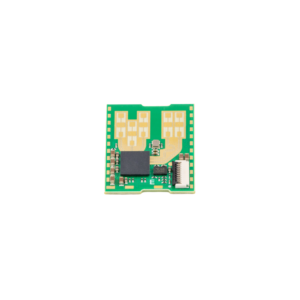
V-LD3 and V-LD3 evaluation kit
Applications such as occupancy sensing, people tracking, smart building automation and touchless user interfaces increasingly rely on mmWave radar technology. Compared to optical sensors, radar operates reliably in darkness, dust, smoke and changing environmental conditions while preserving user privacy.
At the same time, modern radar chipsets have become remarkably powerful. Texas Instruments’ IWRL6432 integrates the radar frontend, processing resources and communication interfaces required to implement sophisticated radar applications on a single device.
The new V-LD3 from RFbeam builds on this platform and combines factory-calibrated RF hardware, integrated antennas and compatibility with TI’s MMWAVE-L-SDK and Radar Toolbox in a compact 20 × 25 mm SMT module designed for direct OEM integration.
The Challenge of Moving from Evaluation to Production
Many radar projects begin with a TI evaluation kit and a proof-of-concept implementation. The available software examples and development tools allow engineers to quickly explore radar technology and validate application concepts.
However, moving from a successful evaluation towards a production-ready product often introduces additional challenges related to RF integration, antenna implementation, calibration, mechanical design, certification and manufacturing.
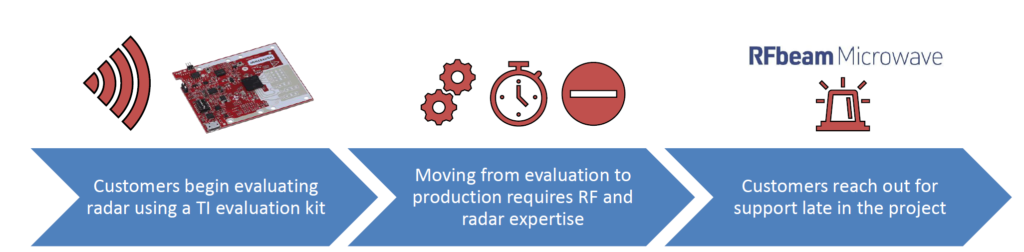
Typical Radar evaluation process
As a result, RFbeam is frequently contacted at a late project stage, when significant development effort has already been invested and major architectural decisions have already been made.
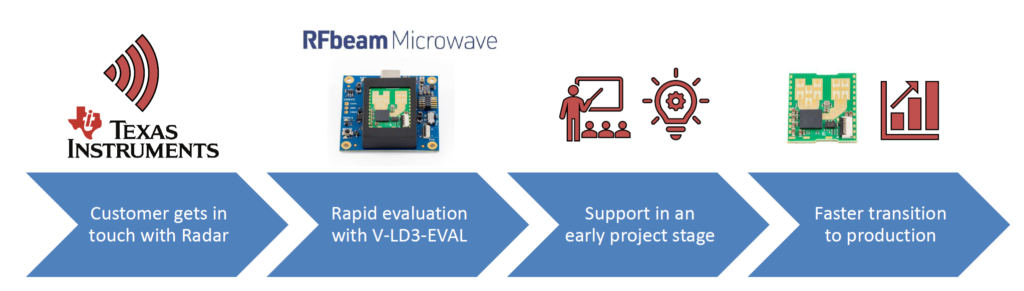
Evaluation process based on V-LD3 platform
The V-LD3 was developed specifically to simplify this transition. By combining production-ready hardware, factory calibration and compatibility with TI’s radar ecosystem, developers can start evaluating radar functionality immediately while maintaining a clear path towards product integration and mass production.
Built on the TI mmWave Ecosystem
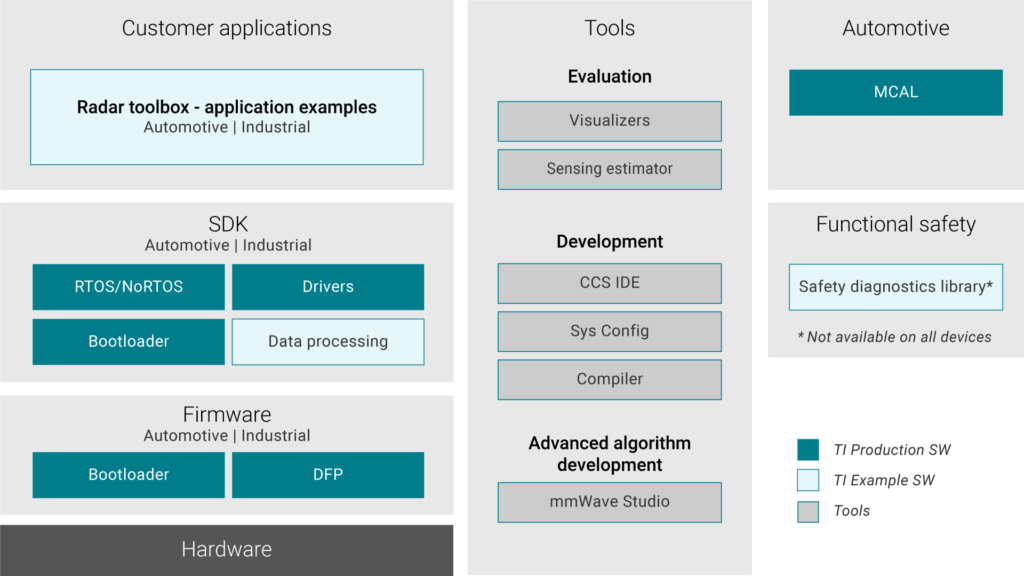
Texas Instruments mmWave Radar Ecosystem Overview
The V-LD3 leverages the complete TI development ecosystem including:
MMWAVE-L-SDK
Radar Toolbox
Industrial Visualizer
Application examples
Tuning guides
Development tools
This allows developers familiar with TI radar devices to immediately use existing tools, workflows and software frameworks.
The same software examples used during evaluation can later be deployed on the V-LD3 platform without changing the underlying software architecture.
Compact Production-Ready Radar Platform
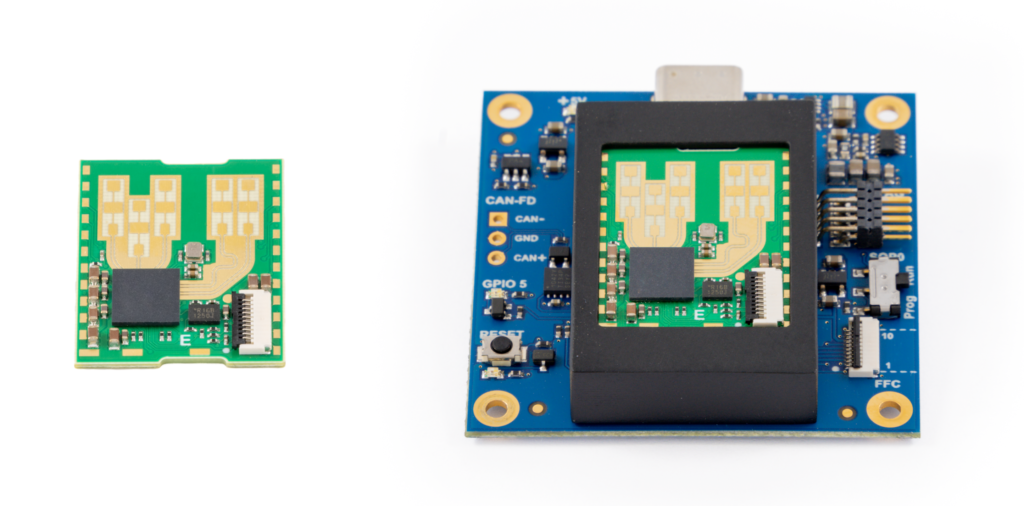
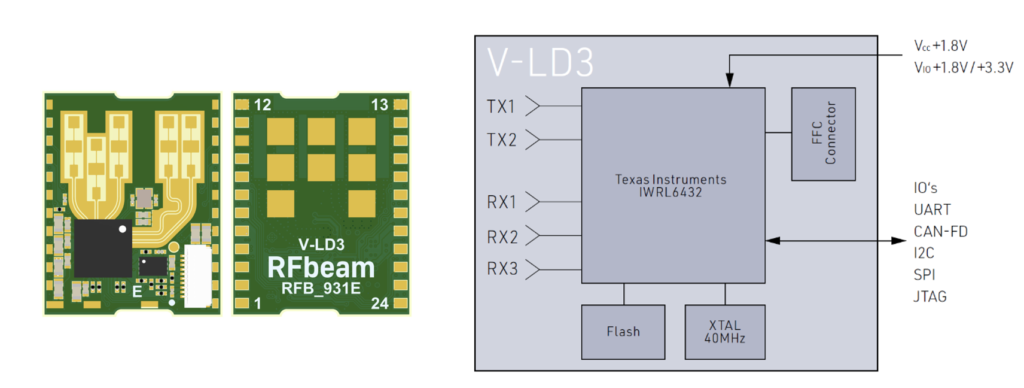
V-LD3 top and bottom view and block diagram
The V-LD3 integrates the complete radar frontend including antennas, RF circuitry, processing resources and communication interfaces into a compact 20 × 25 mm SMT module.
Key features include:
Factory-tested and calibrated hardware
Production-ready SMT module
Integrated antennas
2 TX / 3 RX architecture
110° × 50° Field of View
UART, SPI, I2C, CAN-FD and JTAG interfaces
SMT and FFC integration options
FCC and CE optimized antenna design
Unlike traditional radar evaluation boards, the V-LD3 is intended for direct integration into end products.
Each module is factory tested and calibrated before shipment. Calibration datasets are stored directly inside the module and can be loaded through a CLI command, ensuring consistent radar performance across production volumes.
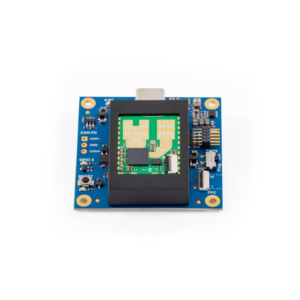
For rapid evaluation and development, RFbeam also offers the V-LD3-EVAL. The evaluation board provides convenient access to UART, SPI, CAN-FD, JTAG and GPIO interfaces through dedicated test points and a USB-C connection, allowing engineers to begin evaluating radar functionality and developing application software immediately.
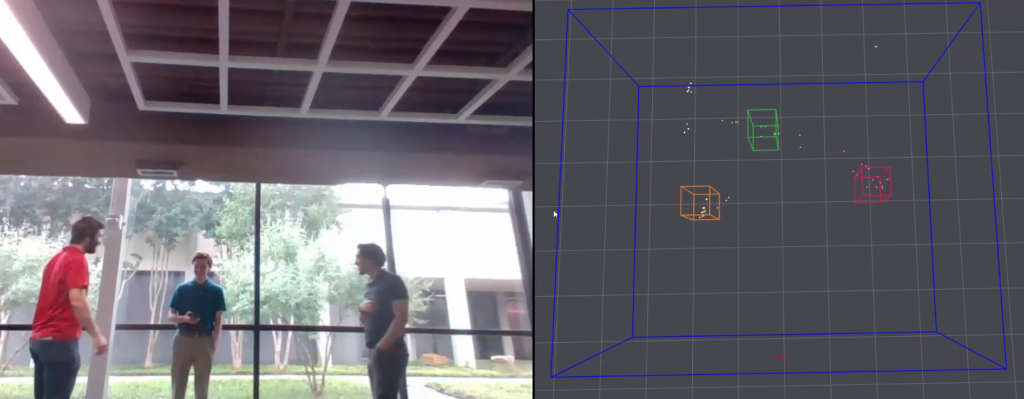
TI Industrial visualizer with motion and presence demo output
Every V-LD3 module is delivered preprogrammed with RFbeam’s enhanced version of Texas Instruments’ Motion and Presence Detection Demo, featuring automatic loading of factory calibration data and optimized radar configurations for the V-LD3 platform.
The demo already provides a complete radar processing chain including:
Presence detection
Motion detection
3D point cloud generation
Multi-target tracking
Human / non-human classification
The radar output can be visualized directly using TI’s Industrial Visualizer and configured through standard CLI commands and configuration files.
For many occupancy sensing, people tracking and smart building applications, the supplied firmware already provides a powerful starting point for rapid prototyping and evaluation.
RFbeam further provides multiple radar configurations optimized for the V-LD3, including automatic loading of factory calibration data.
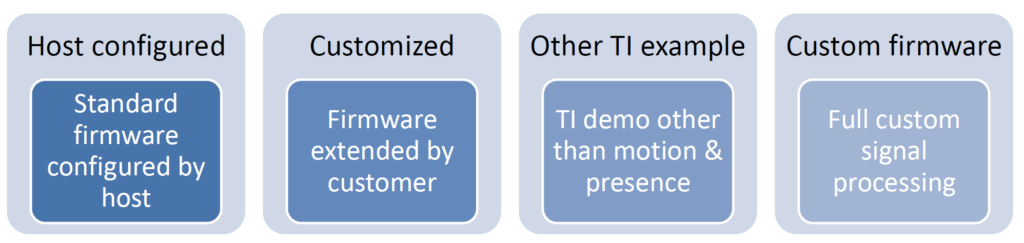
One of the key advantages of the V-LD3 is its scalable integration concept. Depending on project requirements, developers can choose different levels of customization while continuing to use the same hardware platform:
Standard Host-Controlled Applications
Configure radar behaviour through application-specific configuration files while processing point cloud or tracked target data on an external processor.
Use the preprogrammed Motion and Presence Detection Demo together with RFbeam’s optimized configurations as a starting point and fine tune them for your application.
Extend TI’s motion and presence demo with application-specific functionality such as CAN communication, local decision making or custom interfaces.
Use RFbeam’s enhanced motion and presence detection demo with automatic calibration loading from the flash as a starting point.
Full Custom Signal Processing
Develop completely customized radar algorithms while continuing to use the same production-ready radar hardware platform.
This allows projects to evolve from initial evaluation to production deployment without redesigning the radar hardware.
RFbeam can support customers with custom firmware development, radar signal processing and application-specific algorithm design.
Beyond the Default Demo
While the Motion and Presence Detection Demo already covers the requirements of many applications, the compatibility with TI’s Radar Toolbox enables the V-LD3 to serve as a starting point for many additional radar applications.
Radar Toolbox Example
Typical Application
Vital Signs
Contactless breathing and heart-rate monitoring
Pose and Fall Detection
Assisted living and AI sensing
True Ground Speed
Ground speed measurement
Gesture Recognititon
Touchless human-machine interfaces
Small Obstacle Detection
Robotics and automation
Video Doorbell
Smart home presence sensing
These examples demonstrate the flexibility of the underlying radar platform and provide valuable starting points for custom developments.
The V-LD3 combines RFbeam’s expertise in radar hardware design, antenna integration and factory calibration with the powerful software ecosystem provided by Texas Instruments.
The result is a compact and production-ready 60GHz mmWave radar module that enables developers to rapidly evaluate radar technology, implement advanced sensing applications and build customized radar solutions on a proven hardware platform.
Whether used as a ready-to-integrate motion and presence sensor or as the foundation for fully customized radar developments, the V-LD3 provides a practical path from first evaluation to mass production.